Privacy-First AI in Ecommerce Operations
AI is becoming part of everyday ecommerce operations. Sellers are using it to draft listings, summarize return notes, classify support tickets, analyze reviews, build product-data rules, and search internal documents. The next step is not simply “more AI.” It is privacy-first AI that protects sensitive operating data.
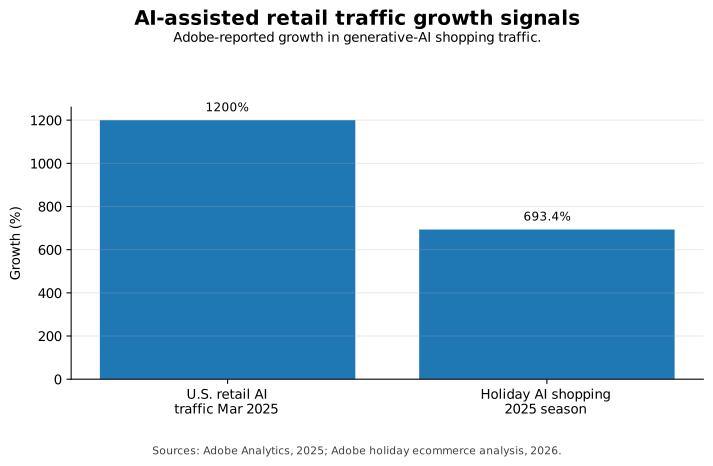
Sources: Adobe Analytics, 2025; Adobe holiday ecommerce analysis, 2026.
Adobe reported in March 2025 that traffic to U.S. retail websites from generative AI sources jumped sharply, and its later 2025 holiday analysis showed continued growth in AI-assisted shopping behavior. Reuters, summarizing Adobe’s 2025 holiday data, reported that AI-powered shopping-assistant traffic rose 693.4% during the season after surging the prior year. This shows that AI is influencing both shopper behavior and seller operations.
For sellers, however, the most valuable AI use cases often involve private data: SKU performance, supplier cost, return reasons, settlement details, customer messages, defect notes, warehouse procedures, and account-health issues. Sending all of that data to external tools without controls can create privacy, compliance, and business-risk concerns.
A practical privacy-first AI strategy has three layers. First, classify data by sensitivity. Public listing copy and product specs are lower risk than supplier invoices, customer messages, or Amazon settlement files. Second, match the model to the task. Local or self-hosted models can handle internal search, summarization, and structured extraction, while cloud models can be reserved for tasks where quality matters more than data sensitivity. Third, keep auditability. AI outputs should connect to source records, human review, and permission controls.
This is where FYERP’s direction matters. /fyerp/ is not just an automation layer; it can become a controlled operating environment where AI helps with real workflows while respecting data boundaries. /digipassport/ connects Amazon SP-API data into a structured module, helping sellers use marketplace data without scattering it across unsecured tools.
The strongest ecommerce AI systems in 2026 will not be the flashiest demos. They will be the systems that save time, protect data, and make better operational decisions every day.
Sources
- Traffic to U.S. Retail Websites from Generative AI Sources Jumps 1,200 Percent — Adobe, 2025
- Adobe: Holiday Shopping Season Drove a Record $257.8 Billion Online — Adobe, 2026
- US online holiday spending hits record levels despite slower growth — Reuters, 2026
- The Llama 4 herd — Meta AI, 2025
- Mistral Small 3.1 — Mistral AI, 2025
← 返回新闻