Returns, Reverse Logistics, and the Circular Economy
Returns are no longer just a customer-service cost. They are a profit, inventory, compliance, and sustainability issue. For ecommerce sellers, reverse logistics can determine whether a product line is truly profitable.
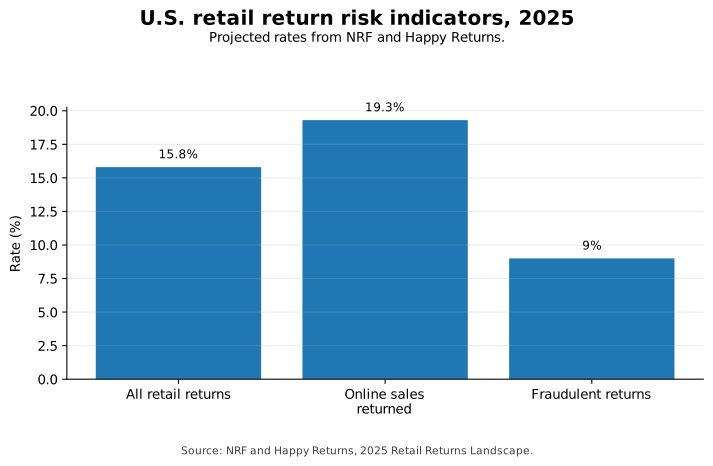
Source: NRF and Happy Returns, 2025 Retail Returns Landscape.
The National Retail Federation and Happy Returns projected that U.S. retail returns would reach $849.9 billion in 2025, representing 15.8% of annual sales. Their 2025 Retail Returns Landscape report also estimated that 19.3% of online sales would be returned in 2025 and that 9% of all returns would be fraudulent. These figures show why sellers need return controls, not just generous policies.
Returns create several hidden costs. There is inbound freight, inspection labor, grading, repackaging, refurbishment, replacement parts, restocking, liquidation loss, customer-service time, platform claims, and fraud exposure. For electronics, sellers may also need serial-number tracking, data wiping, battery checks, accessory verification, and warranty decisioning. For apparel, sizing and condition inspection dominate. For home goods, damage and packaging cost can decide whether an item is recoverable.
The circular economy adds another layer. Returned products should not automatically become waste. Many items can be resold as new-open-box, renewed, used, parts-only, or liquidation inventory. But circular recovery only works when sellers know the condition, cost, and best resale channel. A poor return workflow turns recoverable value into warehouse clutter.
FYERP can help sellers build structured return operations. Return reasons, inspection outcomes, recovery channels, refund decisions, and resale margin should be captured as data. Over time, that data can identify products with high defect rates, misleading listings, packaging problems, fraud patterns, and profitable refurbishment opportunities.
The future of returns is more disciplined and more data-driven. Free returns may remain important to buyers, but sellers need systems that protect margin while preserving customer trust. Reverse logistics is no longer the back office. It is a strategic operating function.
Sources
- 2025 Retail Returns Landscape — National Retail Federation and Happy Returns, 2025
- Consumers Expected to Return Nearly $850 Billion in Merchandise in 2025 — National Retail Federation, 2025
- NRF and Happy Returns Report: 2024 Retail Returns to Total $890 Billion — National Retail Federation, 2024
- Reverse Logistics Market Size & Share 2026–2035 — Global Market Insights, accessed 2026
← 返回新闻