Self-Hostable Local AI Models for Ecommerce Teams in 2026
Local AI is becoming practical for ecommerce teams that want privacy, control, and predictable cost. The goal is not always to replace frontier cloud models. For many seller workflows, a local model is enough for product-data cleanup, return-note summarization, listing draft support, customer-service triage, internal search, and warehouse knowledge-base Q&A.
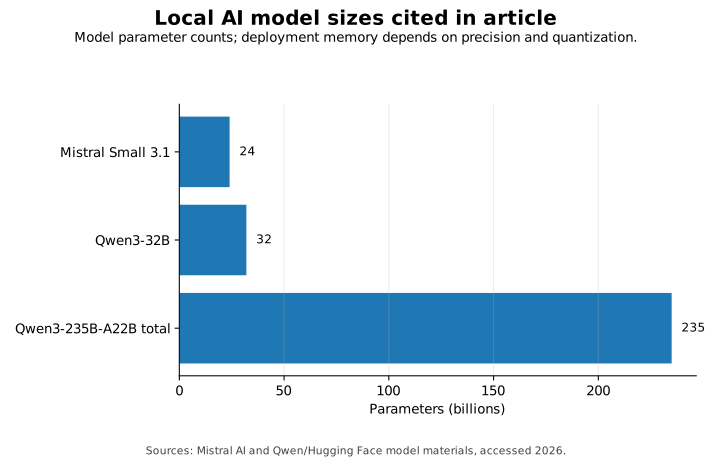
Sources: Mistral AI and Qwen/Hugging Face model materials, accessed 2026.
Three model families deserve attention in 2026. First, Meta’s Llama 4 family introduced open-weight multimodal models such as Scout and Maverick in April 2025. Meta described Llama 4 Scout and Maverick as natively multimodal and built with mixture-of-experts architecture. These models are powerful, but full-scale deployment can require serious infrastructure, so smaller or quantized variants are often more practical for local business use.
Second, Qwen3 is a broad model family covering dense and mixture-of-experts architectures. The Qwen3 technical report describes parameter scales from 0.6 billion to 235 billion, which gives teams a wide range of options from lightweight local assistants to larger server models. Smaller Qwen models can be useful for internal automation, multilingual drafting, and structured extraction.
Third, Mistral Small 3.1 is attractive for teams that care about permissive licensing. Mistral says Small 3.1 is released under Apache 2.0, and its Hugging Face model card notes that running the 24B model in bf16 or fp16 requires about 55 GB of GPU RAM. Quantized deployment can reduce memory needs, but quality, latency, and context length should be tested before production use.
For ecommerce, the safest approach is workflow-first selection. Use small local models for repetitive low-risk tasks. Use larger local models for sensitive internal documents. Use cloud models only where the quality gap justifies the data exposure and cost. Keep humans in the loop for policy, legal, pricing, and customer-impacting decisions.
FYERP’s privacy-first direction is aligned with this approach. Local AI can help sellers improve operations without sending every SKU, return record, or settlement file to a third-party model provider.
Sources
- The Llama 4 herd — Meta AI, 2025
- Qwen3 Technical Report — Qwen Team, 2025
- Qwen3 Collection — Hugging Face / Qwen, accessed 2026
- Mistral Small 3.1 — Mistral AI, 2025
- Mistral-Small-3.1-24B-Instruct-2503 Model Card — Hugging Face / Mistral AI, accessed 2026
← 返回新闻